

Wall Street Took Over New York — Home Care Aides Are Paying the Price.
Big investment firms have been buying up home care agencies across New York. A new study from Cornell University says that for the care aides who work there, things got worse: low pay, missing paychecks, work-related injuries, irregular schedules and bosses who do not offer any help or resources.
Private equity firms are groups of wealthy investors. They buy companies, try to squeeze more profit out of them, and often sell them a few years later.
Why do investors want home-care? Most of it is paid for by Medicaid, the government health program, so the money is steady. Home care aides are among the hardest-working and lowest-paid people in New York’s health care system. They lift and move patients, work long and irregular hours, and often do it alone in a client’s home. When ownership of these home-care agencies switched over to investment firms who arguably put corporate greed over the health of their workers, the patients also pay the price. Researchers at Cornell University studied what happens when private equity firms buy home care agencies.
Here is what research says about the current state of the home-care industry, what is changing, and what rights home care workers have no matter who owns the agency.
WHAT RESEARCHERS FOUND
The researchers found that these firms did not fix the problems aides already faced. Often, they made them worse. Two reports from the Worker Institute at Cornell’s ILR uncovered just how bad the situation is.
The first report, Private Equity Pathways into Home Care: The Case of New York State, was published in June 2026. According to Cornell’s summary, it found that:
- Private equity firms spent nearly $70 billion buying home-care agencies in New York since 2020.
- Under private equity ownership, $2.32 billion in Medicaid revenue was generated in 2022, a figure expected to rise sharply in 2026.
- These agencies changed owners about every five years on average, bringing frequent leadership turnover.
Taking in more than $2 billion a year sounds like a success story for these home care agencies. But look at conditions for the aides on the front lines of an already underpaid industry, and it becomes clear who really benefits from this takeover.
THE SECOND REPORT
The second report, Private Equity’s Impact on Home Care Workers and Patients in New York State, was released in the fall. Researchers interviewed workers at five private equity-owned agencies. Workers described:
- Low wages and wage theft, including unpaid work.
- Unstable schedules, with some workers short on hours and others pushed into 24-hour shifts paid as 13 hours.
- Managers who were hard to reach when a client’s situation became serious.
- Having to work through injuries which are common in home-care industry.
- Apps and automated phone lines replaced real people, so aides had no one to talk to when looking for support.
By research numbers, New York’s home care workforce is large and underpaid. A local report on the Cornell research notes median annual earnings of $25,738 in 2023, with 39% of workers living in or near poverty. The Chief reports that about 87% of these workers are women and 81% are people of color.
Researchers say these problems can also lower the quality-of-care patients receive. They recommend a living wage for home care workers, stronger safety protections, better enforcement of existing labor laws, and protection of workers’ right to organize.
Hurt at work? Tell your employer in writing within 30 days. Then call us. 866-557-7500. You have rights.
BIG CHANGES FOR CDPAP AIDES
If you care for a family member or friend through CDPAP, this part is for you.
CDPAP is the Medicaid program that lets people who need care choose their own aide, often a relative. In April 2025, New York moved the whole program under one company, Public Partnerships LLC, or PPL. Before that, hundreds of different agencies ran it. Now PPL is the employer for almost 200,000 CDPAP aides.
The switch was rough. Many aides reported late or missing paychecks, payroll mistakes and trouble getting help.
THE UPSIDE
There may be one positive outcome out of this unfair takeover. When everyone works for the same company, it is easier to come together as a union. A union lets workers ask for better pay and conditions as a group instead of one by one. In September 2026, about 70,000 CDPAP aides signed cards asking for a vote to join the union 1199SEIU.
If it passes, about 190,000 aides would join, making it the largest union election in U.S. history. The vote is expected to happen by mail. As of mid-November 2026, a date had not been announced.
When aides stand together in a union, they don’t have to fight for fair treatment alone. A union can bargain with the employer for higher pay, better benefits, more reliable schedules and safer working conditions, and put those promises in a written contract the company has to follow. If your paycheck is short or a manager ignores a problem, you have someone in your corner who knows your rights and can push back. And because home care is paid for with public money, a large union gives aides a stronger voice in Albany, where decisions about their wages are often made.
Union or not, you already have legal rights at work. Those are covered below.
HOME CARE IS HARD ON THE BODY
Home care aides get hurt at work far more often than most workers. One government-published study found they miss work from injuries nearly four times as often as the average worker.
The most common injuries are back, shoulder and other strains from lifting and moving clients. Hospitals have lift machines and beds that adjust. Most homes do not, and you are usually doing it alone.
You can get hurt at work by:
- Lifting or moving a client into or out of bed, a chair, the shower or a car.
- Slipping, tripping or falling in a cluttered or unfamiliar home.
- Being hit, pushed or bitten by a client who is confused or upset.
- Getting into a car accident while traveling between clients during your workday.
- Wearing your body down over time from long shifts and repeated motions.
Injuries that build up slowly, like back pain that gets worse over months, can count too. Long shifts and missing support that aides described in the Cornell study make work-place injuries inevitable.
Your rights as a home care aide
No matter who owns your agency, and whether or not you join a union, New York law protects you when you get hurt or are not paid fairly.
If you get hurt at work
Most home care aides, including CDPAP aides, are covered by workers’ compensation. For CDPAP aides, PPL is your employer. Workers’ compensation can pay for your medical care and part of your lost pay while you heal.
Here is what to do, based on the state Workers’ Compensation Board’s rules:
- Get medical care. Tell the doctor you were hurt at work.
- Tell your employer within 30 days. Preferably in writing, like an email, and keep a copy. If you wait longer, you could lose your benefits.
- File your claim (Form C-3) with the Workers’ Compensation Board. You have up to 2 years, but do it as soon as you can, even if your employer already reported it.
Your employer cannot fire you, punish you or cut your hours for filing a claim. That is against the law. You take care of everyone else. When you get hurt on the job, you deserve someone who takes care of you.
At NYCOMPLAW, we help injured workers get the benefits they are owed. If you are a home care aide who got hurt at work, or your claim was delayed or denied, we can help you.
Talking to us is free. Call 866-557-7500 or visit NYCOMPLAW. Hablamos español.
Written by Brian Molina
Marketing Coordinator & Paralegal
RESOURCE FOR HOME-CARE WORKERS
Money from the PPL settlement: On November 10, 2026, a judge approved a $162 million settlement for CDPAP aides paid by PPL who worked in New York City, Nassau, Suffolk or Westchester between March 1, 2025 and April 30, 2026. If that’s you, you do not need to fill out a claim form. Payments are expected in early 2027 if there are no appeals. PPL denies doing anything wrong. Check the settlement website for updates.
Sources
- The Chief, “Private equity’s takeover of homecare has been detrimental to workers in New York, reports reveal,” November 6, 2026 (print edition)
- Cornell Chronicle: Private equity ownership results in poor working conditions in NYS home care
- Cornell ILR Worker Institute: Private Equity Pathways into Home Care
- 1199SEIU: CDPAP union election filing
- Gothamist: Nearly 200K NY home care workers to decide whether to unionize
- NYS Workers’ Compensation Board: Injured Worker’s Toolkit
- FingerLakes1: Judge approves $162 million PPL settlement
This article is for general information only and is not legal advice. Reading it does not create an attorney-client relationship. Every case is different; contact an attorney about your specific situation. NYCOMPLAW — confirm required disclaimers under New York’s Rules of Professional Conduct before publishing.
If You’ve Been Injured at Work
If you or a loved one has suffered a work-related injury, don’t wait to protect your rights and your future. Call 866-557-7500 for a free and confidential consultation.
How Our Experienced Legal Team Can Help You
Navigating the intersection of federal 9/11 claims, New York State Workers’ Compensation, and municipal disability pensions require specialized legal strategy. At McIntyre, Donohue, Accardi, Salmonson & Riordan, LLP, our legal team handles every step of the process on your behalf:
- Establishing Exposure Proof: We locate historical employment records, utility bills, lease agreements, affidavits, or transcripts proving your presence in Lower Manhattan during the qualification period.
- WTCHP Certification Support: We guide you through enrollment in the World Trade Center Health Program so your medical conditions are officially certified.
- Maximizing VCF Financial Awards: We document non-economic losses (pain and suffering) and economic losses (lost wages, loss of union pension accruals, and medical expenses) to secure full compensation.
- Coordinating Disability & Workers’ Comp Benefits: We integrate VCF awards with New York Workers’ Compensation and municipal disability pensions so your rights are protected across all legal avenues.
- Supporting Families with Wrongful Death Claims: We assist grieving families who lost a loved one to a 9/11-related illness in securing survivor benefits and wrongful death compensation.

Stand Strong with McIntyre, Donohue, Accardi, Salmonson & Riordan, LLP
On this 25th anniversary, we reaffirm our dedication to the individuals and families who gave so much to New York and our nation. If you or a family member served, lived, or worked in Lower Manhattan in the months following September 11, 2001, you may be entitled to lifetime medical monitoring and tax-free financial compensation.
Contact McIntyre, Donohue, Accardi, Salmonson & Riordan, LLP today for a confidential, no-obligation consultation. Let our experienced legal team manage the details so you can focus on your health and family.

Day Laborer vs. Contractor: A $200,000 Settlement — NYCOMPLAW
Day Laborer vs. Contractor: A $200,000 Settlement — NYCOMPLAW In the fall of 2014, a day laborer from Inwood, NY, went to a Home Depot in nearby Valley Stream to [...]

Your Employer’s File on You Is No Longer Secret: New York Workers Can Now Demand Their Personnel Records
Your Employer’s File on You Is No Longer Secret: New York Workers Can Now Demand Their Personnel Records As of November 8, 2026, a new state law gives every New [...]
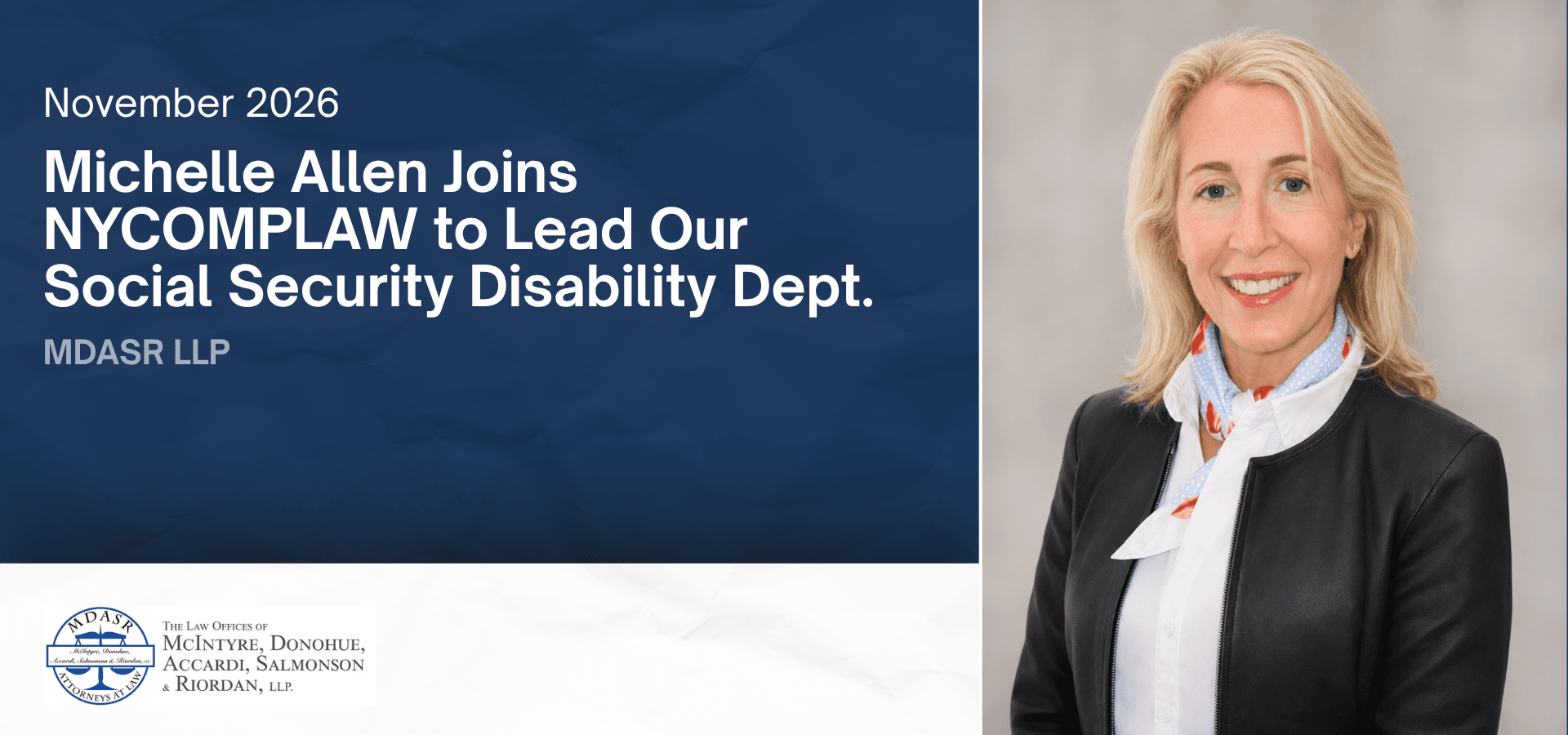
Michelle Allen Joins NYCOMPLAW to Lead Our Social Security Disability Department
Michelle Allen Joins NYCOMPLAW to Lead Our Social Security Disability Department NYCOMPLAW is pleased to announce that former Chief Hearing Office Administrative Law Judge Michelle Allen has joined the firm [...]
Leave A Comment